Research Overview
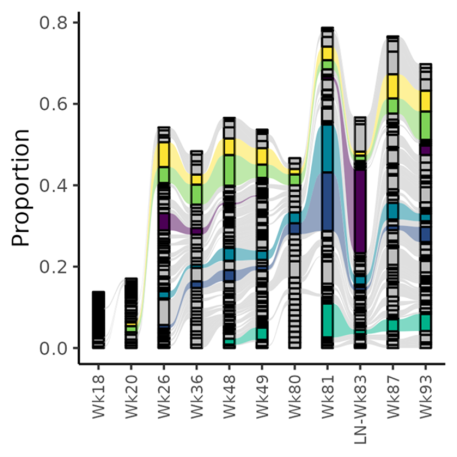
Alluvial plot showing the longitudinal dynamics of the most abundant antigen specific B cell clonotypes (colors) responding to HIV vaccination in an immunized nonhuman primate.
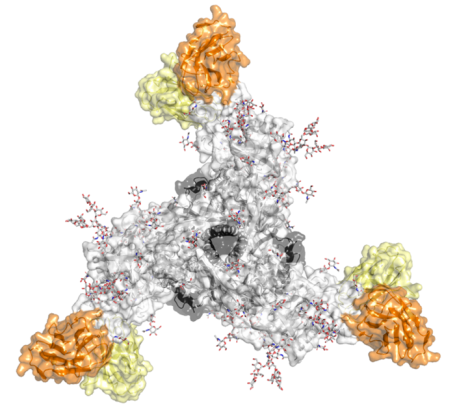
Neutralizing antibody heavy chain (orange) and light chain (yellow) from an immunized nonhuman primate bound to the HIV envelope trimer vaccine antigen (top view).
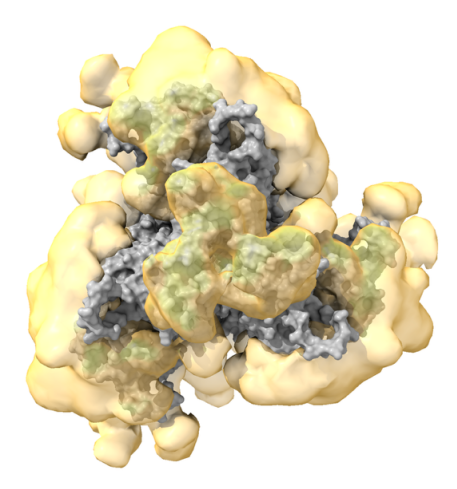
Computational modeling of dynamic glycan coverage (yellow) across an HIV envelope trimer protein (gray) to assess its potential as a vaccine immunogen (top view).
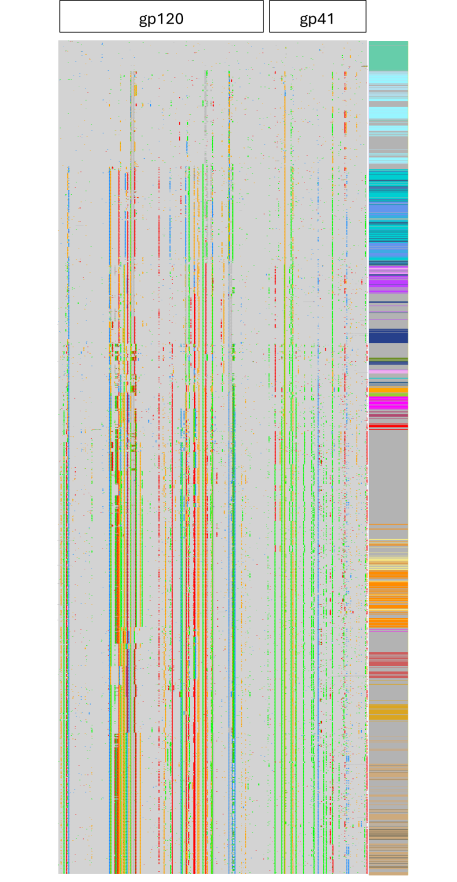
Tick plot showing longitudinal evolution in the HIV-1 envelope sequence in a person living with HIV/AIDS over 42 months. The vertical lines indicate sequence changes from the transmitted/founder viral variant and the horizontal bars indicate the major glycosylation variants.
Selected Publications
Croft JT, et al. Reconstructing a Missing Link of HIV-1 Assembly: HIV-1 Envelope-Matrix Interactions in a Native Viral Context. bioRxiv 2026, :. 41648420
Croft JT, et al. Structure of HIV-1 Env glycoprotein on virions reveals an alternative fusion subunit organization and native membrane coupling. bioRxiv 2026, :. 41542432
Peres A, et al. Population-level genomic analysis of immunoglobulin loci variation in rhesus macaques reveals extensive germline diversity. Immunity 2026, 59:213-228.e6. 41494536
López CA, Alam SM, Derdeyn CA, Haynes BF, and Gnanakaran S. Influence of membrane on the antigen presentation of the HIV-1 envelope membrane proximal external region (MPER). Curr Opin Struct Biol 2024, 88:102897. 39173417
Mopuri R, et al. High throughput analysis of B cell dynamics and neutralizing antibody development during immunization with a novel clade C HIV-1 envelope. PLoS Pathog 2023, 19:e1011717. 37878666
Welbourn S, et al. A neutralizing antibody target in early HIV-1 infection was recapitulated in rhesus macaques immunized with the transmitted/founder envelope sequence. PLoS Pathog 2022, 18:e1010488. 35503780