Bekris Lab
Overview
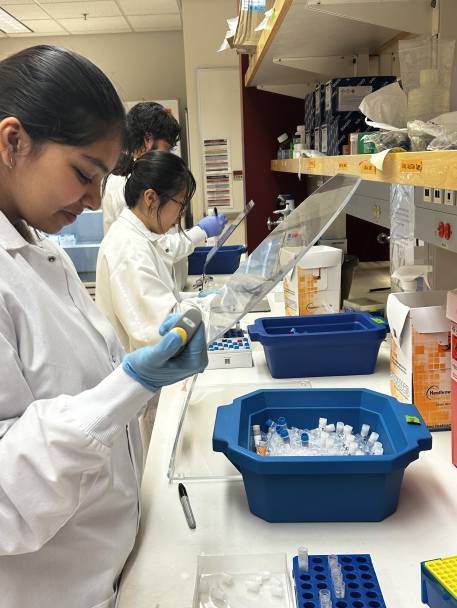
The Bekris lab focuses on teasing apart the heterogeneous nature of neurodegenerative disease by characterizing biomarkers that:
- Predict disease type or risk
- Track disease progression
- Predict resilience to disease progression
- Identify new drug targets
- Monitor treatment effectiveness
The overall goal is to provide effective biomarker tools to support precise neurodegenerative disease diagnosis and treatment.
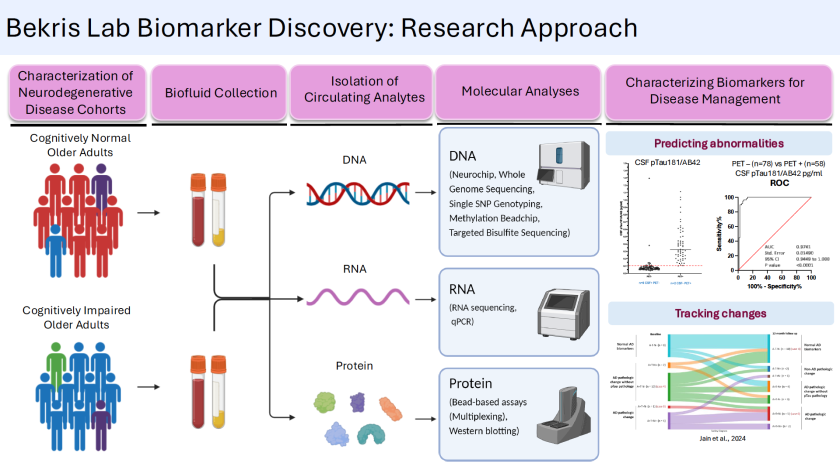
Pictured: Bekris Lab Research Approach Diagram
In the Media
2024 LTA Member for the Year Award
- Venue: Lerner Trainee Newsletter
- Release Date: 8/01/24
- Topic: Recognizing LTA members for their contributions to the mission and the success of their subcommittees and LTA.
Blood-based Biomarkers for Alzheimer’s Disease in Women
- Venue: Cleveland Clinic Neuro Pathways Podcast
- Release Date: 11/01/23
- Topic: A research project aims to pinpoint biomarkers that could speed diagnosis
Changes in the Diagnostic Process of Alzheimer Disease: A New Era of Blood-Based Approaches
- Venue: Neurology Live
- Release Date: 12/08/23
- Topic: The diagnostic value of biofluid biomarkers of Alzheimer's Disease.
Principal Investigator
 |
Lynn Bekris, Ph.D.Lynn M. Bekris, PhD. is Professor of Laboratory Medicine and Pathology at the University of Washington. Bekris lab research focuses on Brain Disorder Biomarker Discovery. Clinical and experimental research approaches are utilized to demonstrate the feasibility of genetic, epigenetic and protein factors as circulating biomarkers of disease risk, progression, and therapeutic outcomes. |
Staff Scientists
 |
Maggie Chung, B.S.Maggie Chung is a Research Tech III in the Bekris Lab. She graduated from the University of Washington with a bachelor's in Bioengineering, minoring in both Microbiology and Business. While in undergrad she conducted research in the Paul Yager lab on the development of a point-of-care microfluidic device for testing HIV RNA. |
 |
Hannah Newcombe, M.P.HHannah Newcombe, M.P.H (they/them) is the Research Coordinator for the Bekris Lab. They have backgrounds in epidemiology, public health program coordination, and microbiology. Their research interests include healthy aging, science communication, LGBTQ+ health, and the relationships between social connection and wellbeing. They graduated with an undergraduate degree in Microbial Biology from the University of California, Berkeley and received their M.P.H. in Epidemiology from the University of Washington. |
 |
Nam Phuong Nguyen, Ph.D.Nam Phuong Nguyen, Ph.D., is the Operations Manager for the Alzheimer’s Disease Research Center and the Bekris lab. She has an interdisciplinary background in experimental research spanning various research areas including nanotechnology, neuroscience, and vascular engineering. Her interests center around clinical research and translational technologies that improve overall brain health outcomes. She received her undergraduate degree in Materials Science & Engineering from Stanford University, followed by a Ph.D. in Molecular Engineering from the University of Washington. |
Trainees/Mentees
 |
Rene Coig, Ph.D.Rene Coig, Ph.D., is a Postdoctoral Scholar in the Bekris Lab in the UW Medicine Department of Laboratory Medicine and Pathology. His research focuses on fluid biomarker discovery in high-dimensional omics data to understand how sex-related biology shapes an individual’s susceptibility and resilience to Alzheimer’s disease and related dementias. He aims to develop computational and AI-enabled approaches that help guide the development of more effective treatment strategies for cognitive decline. Rene received his B.A. and B.S. from Louisiana State University and the University of Washington. He received his Ph.D. in Molecular Medicine and Mechanisms of Disease from the University of Washington. |
 |
Daniel Fisher, M.D./Ph.D.Daniel W. Fisher MD PhD is a Acting Instructor in the Department of Psychiatry Behavioral Sciences. He completed his undergraduate degree at the University of Texas, MD and PhD and Northwestern University, and completed his psychiatry residents at University of Washington. His research interests are focused on the cellular and molecular mechanisms of neuropsychiatric symptoms that develop in dementia as well as how the peripheral immune system influences neurodegenerative disease. |
|
|
Manizhe Eslami-Amirabadi, M.D.Manizhe Eslami-Amirabadi, MD, is a Behavioral Neurologist and Assistant Professor of Neurology in the UW Memory and Brain Wellness Center. As a faculty researcher affiliated with UW Dementia Research Center (ADRC), she collaborates with the biomarker core/Bekris Lab on developing accessible and reliable biomarkers that enable early diagnosis, accurate patient stratification, and facilitate disease-modifying clinical trials ultimately to improve care across the spectrum of TDP-43 proteinopathies across the lifespan. Her research interests also include investigating the ethical aspects of dementia and functional cognitive disorder (the ethical challenges associated with diagnosis, prognosis, communication of research and paraclinical test results, and supported decision-making by individuals living with dementia). |
 |
Manavi ManunathManavi Manjunath is a second-year undergraduate student at the University of Washington, intending to pursue a Bachelor of Science in Neuroscience. Her research interests include discovering and validating biomarkers for ARIA and the intersection of diabetes and Alzheimer’s disease. |